




Low-effort Microgestures
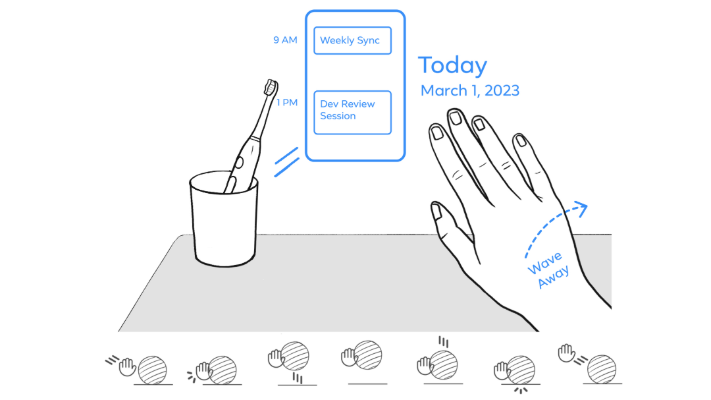
Investigating ergonomic factors for subtle input design.
I am an Assistant Professor in Computer Science at the University of Bath, where I lead the Advanced Interaction and Sensing (AIS) Lab. I also hold an honorary appointment with NHS Bristol Trust and am a Fellow of the Association of British Science Writers.
My research bridges Machine Learning and Human–Computer Interaction to enable always-available computing. At the AIS Lab, we develop practical solutions in three areas:
Our lab specializes in developing novel approaches to interaction design, sensing, and AI, creating new ways for people to engage with computing systems, especially when hands are busy or attention is focused elsewhere. Our research is published in top venues including ACM CHI, UIST, DIS, and TOCHI, and has been featured by major media outlets such as the BBC, NPR, and The Independent.
I received my Ph.D. from the Human–Computer Interaction group at the Max Planck Institute and Saarland University in Germany. My experience spans both industrial and academic labs, enabling me to translate novel research into scalable technologies with real-world impact in healthcare and consumer applications.
Outside the lab, I collect fountain pens, enjoy clever puns, and love strolling in new cities. I welcome connections regarding student opportunities and research partnerships, or simply to chat about my experiences living across seven countries. Please feel free to contact me.
To create always-available computing systems that seamlessly integrate into daily life, enabling inclusive, impactful, and practical human-technology interactions.
Explore researchInvestigating ergonomic factors for subtle input design.
Reappropriating everyday objects into intelligent agents.
Solving complex perception problems with minimal data points.
Creating near-zero latency inference pipelines that priortize privacy.
Seamlessly integrating digital control into physical tasks, solving the disconnect between the task at hand and technology to support the primary action without interruption — across contexts like:
Ensure immediate accessibility for motor-impaired users and sterility for clinicians via contact-free, low-effort interactions.
Anticipate users' needs using ambient sensing to adjust comfort instantly, eliminating the need for loud, explicit commands.
Preserve attention for commuters using continuous eyes-free interaction that ensures safety while navigating busy streets.
Augment manual workflows with tool-aware AI agents that proactively verify precision and safety in demanding work environments.

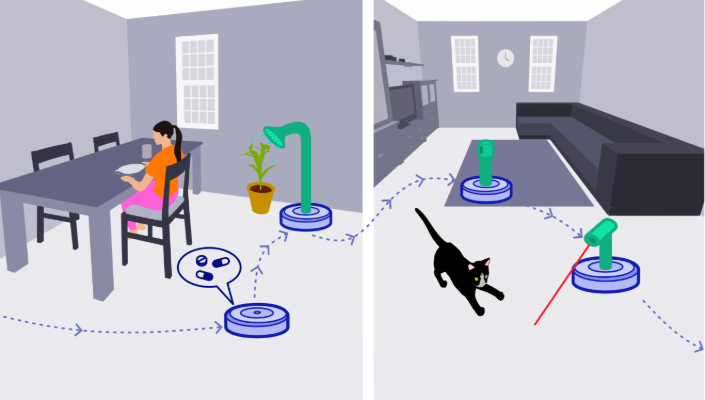
Reappropriating idle domestic robots for ubiquitous computing, providing over 100 use cases and a design space to guide researchers and designers.
Learn More
Design space for object-centric microgesture interactions throughout the grasping process, from pre-grasp to post-grasp phases.
Learn More
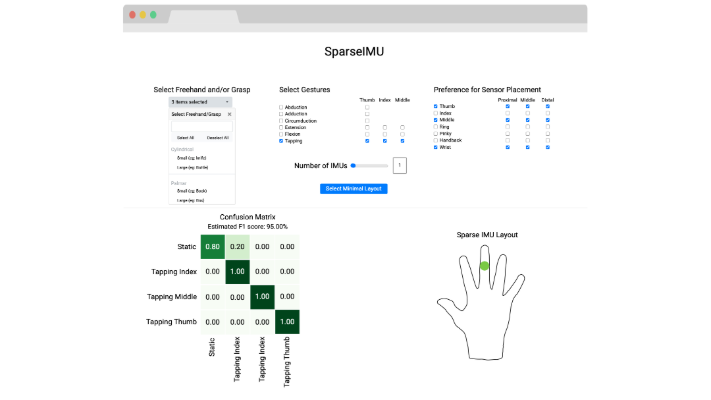
Computational design tool to solve a multi-factorial problem of recognizing always-available input with minimal sensors.
Learn More
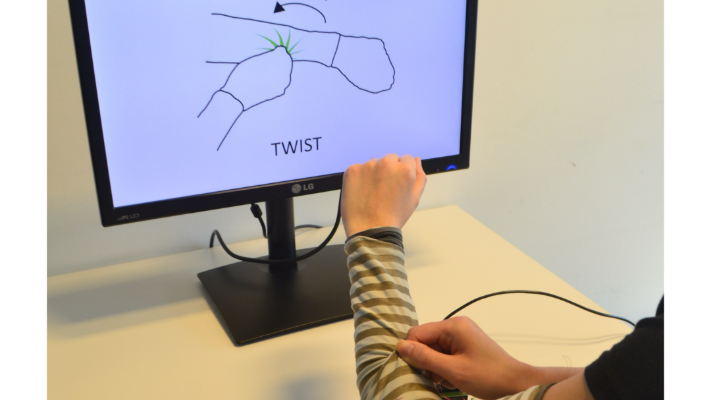
Wearable textile that can detect 22 surface and deformation gestures, such as twirl, twist, fold, push, and stretch—in real time.
Learn MoreNote on publication venues: In my research area of human–computer interaction, ACM CHI, UIST, DIS, and TOCHI are the most influential venues. CHI is consistently ranked #1 by Google Scholar and Microsoft Academic. Each venue follows a multi-stage, highly selective review process, with submissions evaluated by 4–6 international topic experts and program committee members.
The University of Bath is recognized as a top institution globally. See our ranking here.
For prospective students: The Advanced Interaction & Sensing Lab is part of the BathHCI group in the Department of Computer Science at the University of Bath. Working as one team, we value the word our, not mine or yours — because progress, ownership, and learning belong to everyone together.
We are an interdisciplinary group brought together by curiosity and a desire to solve problems that matter. Our backgrounds span interaction design, machine learning, electronics, and psychology, but what unites us is how we work: with respect, openness, and inclusivity. Diverse perspectives make the work stronger, and everyone should feel welcome to contribute, question, and grow. We share ownership of both our successes and our failures.
If you are interested in undergraduate or master’s dissertations, research visits, PhD, or postdoctoral opportunities, feel free to reach out to as5339@bath.ac.uk. Let’s explore what we can build together.
The Advanced Interaction & Sensing Lab actively collaborates with industry partners to translate cutting-edge research into real-world impact. We work with companies ranging from early-stage startups to global organizations, offering access to deep expertise in interaction design, robotics, sensing technologies, and human-centric AI.
Partners can engage with the lab through research consultancy, sponsored research projects, and long-term strategic collaborations. We also provide opportunities to work with and evaluate technologies using our state-of-the-art facilities, including our markerless motion capture studio for studying human movement, interaction, and behavior in naturalistic settings.
Collaboration models are designed to be flexible and industry-friendly. We support clear, well-defined intellectual property (IP) arrangements from the outset, including options for foreground IP ownership, licensing, and joint exploitation, in line with University of Bath policies. This ensures that both academic and commercial objectives are aligned, enabling partners to confidently invest in research that can move beyond the lab and into products, services, and deployed systems.
If your organization is interested in shaping future interaction technologies, sponsoring impactful research, or exploring bespoke collaborations, we would be delighted to discuss partnership opportunities. Please reach out to Adwait at as5339@bath.ac.uk.
Dr. Adwait Sharma
Wessex House, 9.11
Department of Computer Science, University of Bath
Claverton Down, Bath, BA2 7AY, UK
Telephone: +44 1225 387592
Email: as5339@bath.ac.uk