Abstract
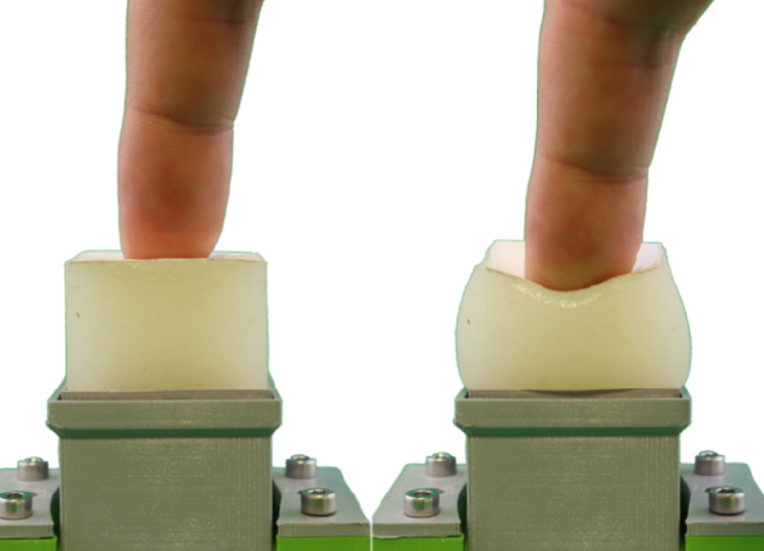
Force-based input offers a promising alternative to traditional touch interactions, providing a pressure-sensitive dimension for digital control. However, the physical properties of the surface—such as its rigidity, deformability, or movability—can significantly influence how users perceive and perform force-based tasks. In this work, we present a systematic investigation into the impact of these surface properties on force-input interactions. We evaluated three distinct surface conditions: rigid (standard glass), deformable (silicone-based), and movable (spring-mounted). Through a series of target acquisition and pressure-tracking tasks, we quantified performance in terms of accuracy, stability, and speed. Our results reveal that while deformable surfaces provide better haptic feedback for fine-grained pressure control, rigid surfaces offer faster response times for binary-like force triggers. We conclude with a set of design recommendations for choosing surface materials based on the desired interaction complexity and tactile feedback requirements in pressure-sensitive devices.