Abstract
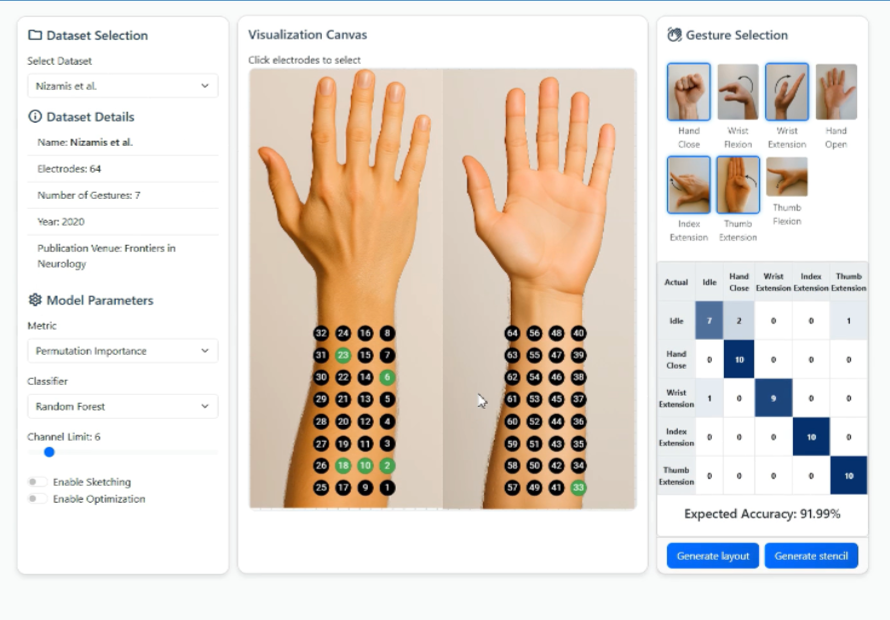
Electromyography (EMG) is a powerful modality for sensing muscle activity and recognizing subtle finger gestures. However, finding an effective but sparse electrode layout remains a significant challenge for designers, as the placement significantly impacts recognition accuracy and device form factor. In this work, we introduce SparseEMG, a computational design tool for the rapid prototyping of sparse EMG layouts. Our approach leverages a large-scale dataset of high-density EMG recordings to simulate and evaluate thousands of potential sparse configurations. We provide a GUI-based tool that allows designers to specify target gesture sets and hardware constraints, automatically suggesting the most performant and robust electrode placements. We validate SparseEMG through a series of experiments, demonstrating that computationally optimized sparse layouts can achieve recognition accuracies comparable to high-density arrays while significantly reducing hardware complexity and power consumption.